
Key takeaways
- Smile Story's first site was a $50 starter build from JitterSystem's early days. We rebuilt it completely in one day, more than 45 pages, free, as an upgrade for an existing client.
- The new site has a custom glass-logo design, 9 treatment pages and 35 dental guides with 46 research charts and 143 linked sources.
- We removed every "best" and "No. 1" claim, because India's dental ethics rules restrict how dentists advertise.
- Every page has schema markup, the sitemap lists 52 pages, and Google read all of them the day we submitted it.
- Google Analytics now tracks bookings, calls and WhatsApp taps, without sending any patient details.
Most case studies start with a big number. This one starts with a small one: $50. That's what Smile Story's first website cost, built when JitterSystem was just getting started. This guide walks through how we turned it into a site the clinic can grow with, step by step, so you can copy the parts that fit your own practice.
The short version
Smile Story Dental Clinic is a dental practice in Karuppayurani, Madurai, led by Dr. S. Nagarathinam, MDS.
We rebuilt its website at smilestorydentistry.in with a custom design, rewritten treatment pages, 35 researched dental guides, clean schema markup and Google Analytics tracking for bookings. The whole rebuild, more than 45 pages, took us one day, and it was free, because the clinic had trusted us with its first site and referred other doctors to us since. The clinic has shared its side of the story on its own blog: our new website, and the team that built it.
The clinic: Smile Story Dental Clinic, Madurai
Smile Story offers root canal treatment, dental implants, braces and aligners, smile design, whitening, children's dentistry, extractions and gum care. Patients come from Karuppayurani and the neighboring parts of Madurai, and most first contact happens on the phone or WhatsApp, not through email forms.
That shaped every decision. The site had to load fast on phones, make calling or messaging the clinic a single tap, and answer the questions people actually type into Google before they book a dentist.
Where it started: a $50 starter site
When JitterSystem was new, we built Smile Story a simple site for $50. It did its job: it listed the treatments, the timings and a booking button. But looking at it again this year, the gaps were clear:
- A generic look. A clinic photo hero, a pop-up promotion and a layout that looked like many other clinic templates.
- Claims dentists shouldn't make. Headings like "Best Dental Clinic in Madurai" and "Why We're the Best Dental Hospital in Madurai".
- Thin content. Treatment pages, but no in-depth answers to the questions patients search for.
- Almost invisible to Google. Google Search Console showed only 4 pages discovered from the old sitemap.
- No measurement. No way to see which pages brought in bookings or calls.
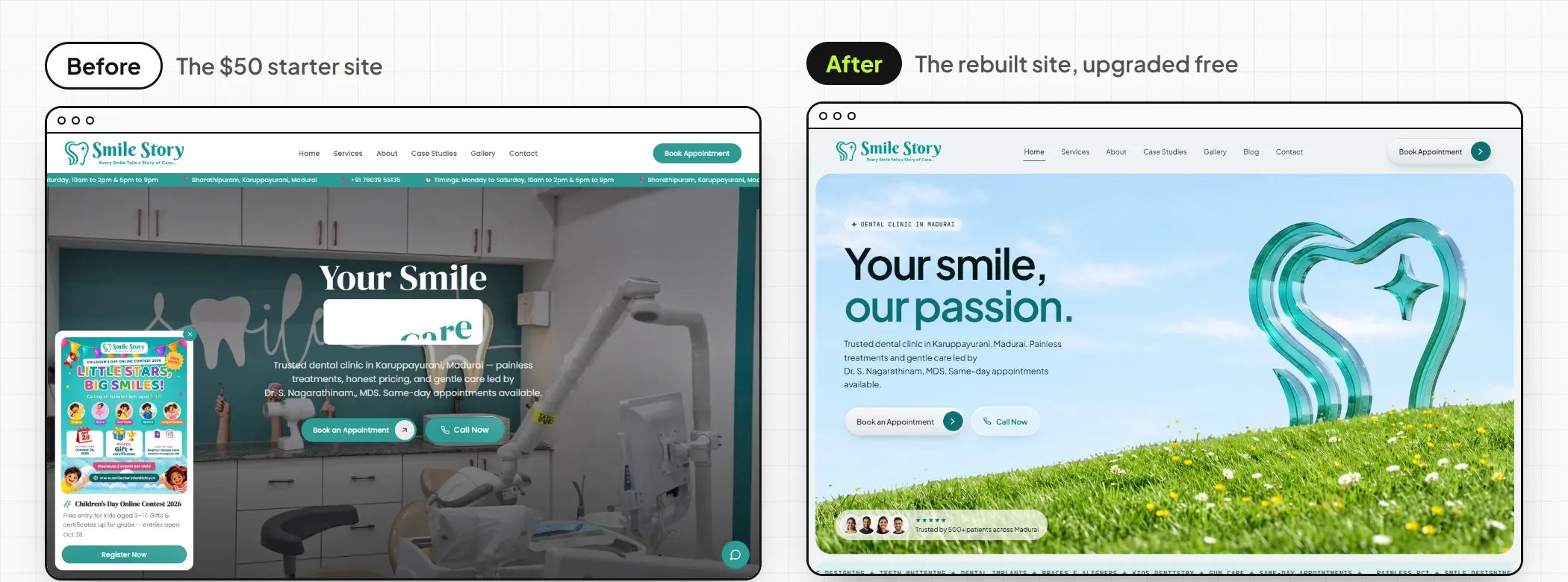
The redesign: built around the clinic's own logo
Smile Story's logo is a tooth drawn as a flowing line with a sparkle. Instead of putting it in a corner, we made it the centerpiece: a glass sculpture of the logo standing on a grassy hill, under an open sky. The idea is calm, clean and memorable, which is how you want a dental clinic to feel before someone walks in.
- One visual idea everywhere. The same sky, grass and glass logo appear in the hero, inside the frosted treatment cards, in the call-to-action and on every inner page.
- A treatment picker that moves. On desktop, hovering a treatment animates in its icon and description. On phones, each treatment unfolds like an accordion.
- Booking through WhatsApp. The booking form fills in a WhatsApp message to the clinic with the patient's name, treatment and preferred time, because that's how patients in Madurai prefer to reach a clinic.
- Built for phones first. A sticky header, a full-screen menu and one-tap call buttons.
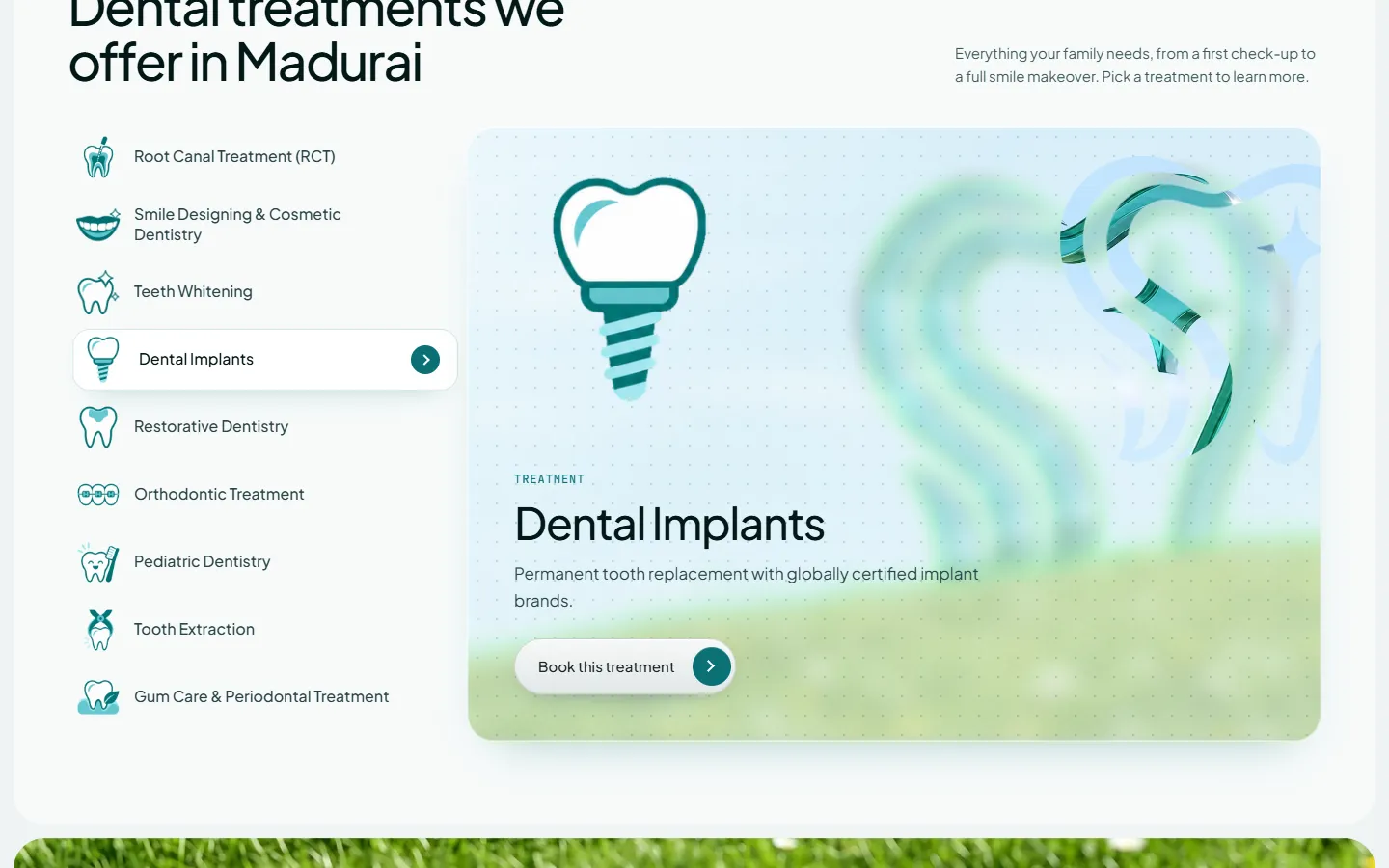
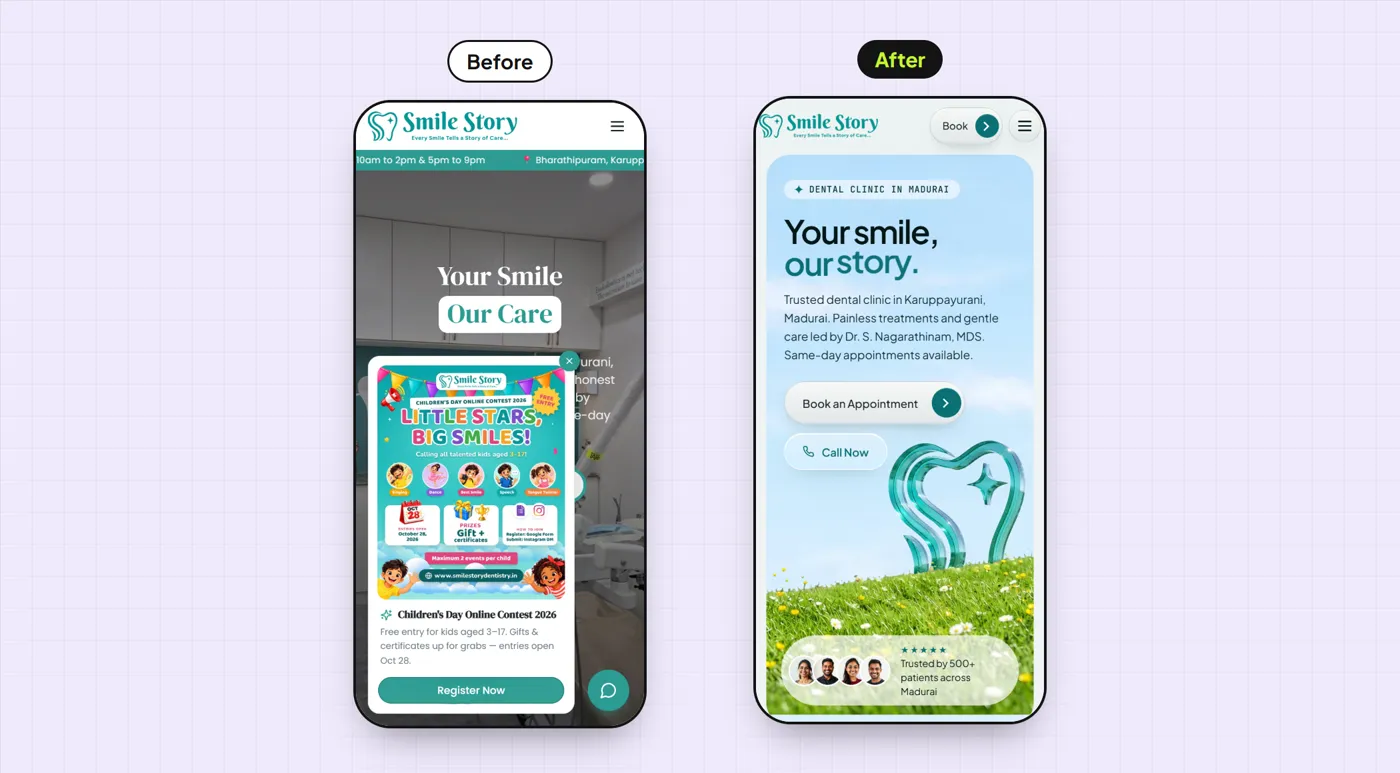
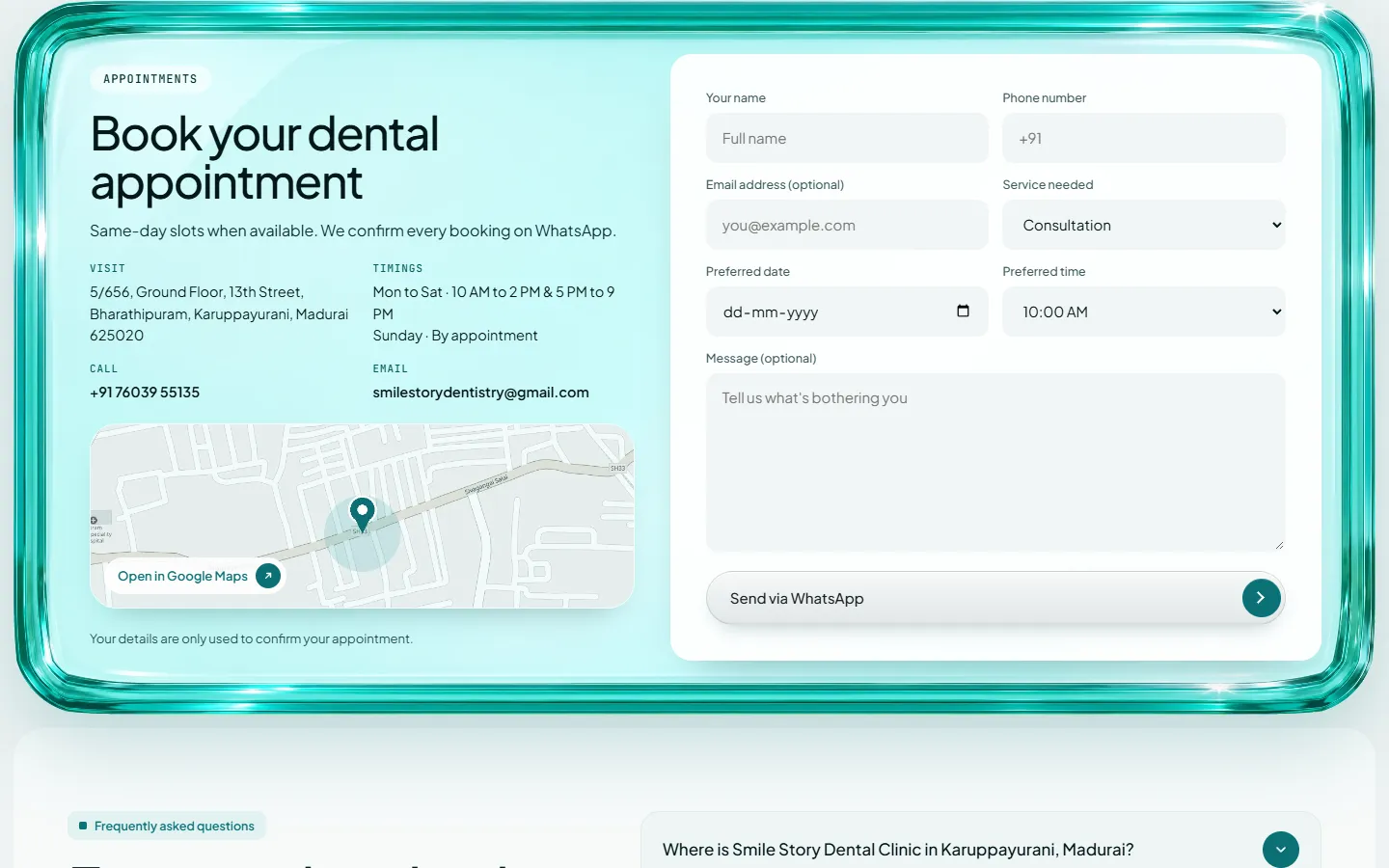
35 research-backed dental guides
A beautiful site still needs reasons for Google to show it. So we studied which topics nearby clinics were writing about, and wrote a better guide for each one: 35 in total, from signs you need a root canal to bleeding gums when brushing.
Every guide followed the same process:
- Check what already ranks. We pulled the top 5 Google results in India for each topic and listed every subtopic they cover.
- Cover all of it, plus one thing nobody else does. Each guide answers everything the top results answer, then adds one section of its own, like a 72-hour checklist after wisdom tooth removal or a note on high fluoride in Madurai's groundwater.
- Back it with research. 46 charts built from published studies, such as Indian surveys on gum disease and childhood tooth decay, each with its source printed on the chart.
- Link the evidence. 143 sources across the guides, every link checked, with PubMed citations confirmed through PubMed's own database.
- Connect the pages. Each guide links to the matching treatment page and to related guides.
Medical advertising rules shaped the copy
Healthcare websites can't be written like product pages. In India, the Dental Council of India's code of ethics restricts how dentists advertise (see the Indian Dental Association's code of ethics page). So we made three rules for the Smile Story site:
- No superiority claims. We removed every "best", "leading", "No. 1" and "most trusted" from the site's own copy, about 30 in total, and wrote plain descriptions instead, like "Dentist and Dental Clinic in Madurai".
- Plain, calm health language. Every guide explains symptoms and treatments in everyday words, without scare tactics or dramatic claims.
- Leave real reviews alone. Patient reviews stay exactly as written, even when a patient calls the clinic "one of the best".
Every guide also carries a clear note that it shares general information and doesn't replace a dental exam, and the byline is the clinic's dental team rather than a doctor who hasn't reviewed the page.
The technical SEO behind it
Here's what changed under the hood, page by page.
| Item | Before | After |
|---|---|---|
| Clinic schema | None | Dentist schema with address, hours, phone, doctor and all nine treatments (Google's local business guidelines) |
| Page schema | None | Medical page, treatment and breadcrumb schema on every page |
| Sitemap | 4 pages discovered | 52 pages, each with a last-updated date (how sitemaps work) |
| Page descriptions | One shared description on many pages | A unique description for every page |
| AI assistants | Nothing | An llms.txt file listing the clinic, hours, treatments and every guide |
| Social sharing | Missing on the homepage | Share image, title and description on every page |
| Missing pages | A generic error | A branded 404 page that links back to treatments and guides |
When we submitted the new sitemap in Google Search Console, Google read it the same day and discovered all 52 pages.
Tracking every booking, call and WhatsApp tap
A website should tell you which pages bring in patients. We set up Google Analytics 4 with three actions counted as conversions:
- Booking form sent, recorded with the treatment the patient picked, using Google's recommended generate_lead event.
- Call taps on any phone link.
- WhatsApp taps on any WhatsApp link.
No names, phone numbers or messages are ever sent to Google. We also linked Search Console to Analytics, so the clinic can see which searches lead to which pages and which pages lead to bookings. Because the site now uses analytics cookies, we've recommended a short privacy notice in line with India's data protection framework.
How to build a dental clinic website: the checklist we used
If you run a clinic, or build sites for clinics, here's the same process in order. Each step works without us.
- Start from how patients contact you. If they call or WhatsApp, make those one tap away on every screen. Don't force an email form.
- Design around your own brand. Your logo, colors and clinic should be the visual idea, not a stock template.
- Write one page per treatment. Name each page the way people search, like "Root Canal Treatment in [your city]", with steps, FAQs and a booking button.
- Check the rules before writing. Remove superiority claims and follow your country's medical advertising rules.
- Research what already ranks. For every guide, read the top 5 Google results, cover everything they cover and add one thing they don't.
- Back health claims with sources. Link real studies and official health sites, and add a "not medical advice" note.
- Add schema. Dentist or medical business schema on the homepage, and page and breadcrumb schema everywhere else.
- Publish a sitemap and submit it in Google Search Console, then request indexing for your most important pages.
- Track bookings, not just visits. Count form sends, calls and WhatsApp taps as conversions.
- Keep publishing. Watch what nearby clinics write about and answer those questions better.
What Dr. Nagarathinam said
Dr. S. Nagarathinam, MDS, sent us a short video review about working with JitterSystem on the clinic website and later on college work.
"You have maintained the clinic theme and everything you have done very professionally, and I like it very much. And even I have referred many of my colleagues."
What happens next
It's too early for traffic and booking numbers: the new site and guides went live in November 2026, and new pages usually take weeks to settle in Google's results. We'll update this case study with real numbers from Search Console and Analytics once there's enough data to be meaningful.
In the meantime, the work continues: a team page so Google understands who is behind the guides, a Madurai-focused section on every page, more guides as nearby clinics publish new topics, and the privacy notice.
Related guides
Frequently asked questions
How much did the Smile Story website cost?
The first version was a $50 starter site JitterSystem built when the agency was just starting out. The full rebuild described in this case study was done free of charge as an upgrade for an existing client.
How long does it take to build a dental clinic website?
A simple brochure site can go live in a few days. We rebuilt the Smile Story site, more than 45 pages with a custom design, nine treatment pages, 35 researched guides, schema and tracking, in one day.
Can a dental website say "best dentist"?
In India, the Dental Council of India's code of ethics restricts how dentists advertise, so self-praising claims like "best" or "No. 1" are risky. We removed them from the Smile Story site and use plain, descriptive wording instead, such as "Dentist in Madurai".
Do dental blog posts actually help bring in patients?
They help people find the clinic while they research a problem, such as bleeding gums or a toothache, and they give Google more reasons to trust the site. They work best when each guide answers the question fully, cites real research and links to the matching treatment page.
Is the Smile Story website tracked?
Yes. Google Analytics 4 records page visits plus three actions: booking form submissions, call taps and WhatsApp taps. No patient names or phone numbers are sent to Google.
Can JitterSystem build a website like this for my clinic?
Yes. Book a call and we'll look at your current site, your treatments and your market, and explain what we would change first.

Want a website like this for your clinic?
Book a free 1:1 call with Prajith. We'll look at your current site, your treatments and your market, and show you what we'd change first.
Book a callIf you want a website like this for your own practice, see how we handle SEO for service businesses and patient lead generation for clinics, from the first ad to the booked consultation.
About this case study

Written by Prajith, founder of JitterSystem
Prajith runs JitterSystem, a full-funnel client acquisition agency for service businesses. He built both versions of the Smile Story website described here and writes these case studies from the work JitterSystem does for clients.
Last reviewed: November 21, 2026. We'll update this case study with traffic and booking results.
Disclosure: JitterSystem built the website described here. The upgrade was done free of charge, and Smile Story did not pay to appear in this case study.
Corrections: if you spot something out of date, email [email protected] and we will check it.
Sources
- Smile Story Dental Clinic website. smilestorydentistry.in
- Indian Dental Association. "Code of Ethics." ida.org.in
- Google Search Central. "Local business (LocalBusiness) structured data." developers.google.com
- Google Search Central. "Learn about sitemaps." developers.google.com
- Google Analytics Help. "Recommended events." support.google.com
- llms.txt proposal. llmstxt.org
- Ministry of Electronics and Information Technology, Government of India. "Data Protection Framework." meity.gov.in